
Booking a Car Service to the Airport: Buffers, Timing and Risk
How to book a car service to the airport properly: plan backwards from boarding, build honest buffers for motorway and security, and cover early flights.
Everyone writes about arrivals: the name board, the delayed flight, the meet-and-greet. But a car service to the airport solves the harder half of the problem. On the way out, there is no flight tracker working in your favour. The aircraft leaves when it leaves, and every minute of risk (the motorway, the drop-off lane, the security queue) sits on your side of the equation.
A departure runs on a deadline you do not control. That makes the booking decision a timing calculation, not a comfort choice. This guide covers how to make that calculation honestly: planning backwards from boarding, building buffers that reflect real roads at real hours, and handling the early-morning flights where most departure plans quietly fail.
Plan Backwards from Boarding, Not Forwards from Home
The common mistake is to start from “how long is the drive?” and add a bit. The reliable method starts at the other end.
Take your boarding time, not departure; gates close 15 to 30 minutes before the aircraft moves. Then work backwards through everything between the kerb and the gate: security, passport control if you are leaving Schengen, the walk (at Schiphol, some gates are a genuine fifteen-minute walk from security), bag drop, and the queue in front of you at each stage. Then, and only then, add the drive.
The drive itself should be counted at its realistic worst for that hour, not its average. Amsterdam to Schiphol is about 20 minutes on an empty A4; in the morning peak it is not an empty A4. A useful rule: the buffer protects the leg you cannot recover. A slow security queue can sometimes be walked faster; a stationary motorway cannot.
Buffer Maths for a Real Departure
Here is the backwards calculation for a common case: a 10:00 intercontinental departure from Schiphol, leaving from Amsterdam Zuid with hold luggage.
| Stage | Time allowed | Clock |
|---|---|---|
| Boarding closes | 09:30 | |
| Security, passport control, walk to gate | 60 to 75 min | be airside by 08:15 |
| Bag drop and check-in queue | 30 to 45 min | at the desk by 07:30 |
| Drop-off, luggage out, walk to the right entrance | 15 min | at the kerb by 07:15 |
| Drive, counted at rush-hour worst | 45 min | leave by 06:30 |
| Loading at your door | 10 min | pickup 06:20 |
A 20-minute drive became a 06:20 pickup for a 10:00 flight. That is not paranoia; it is the sum of stages that each look small. In quiet conditions you arrive with time for a coffee airside; in bad conditions you still make the flight, which is the entire point. Time spare at the gate costs a coffee; time short costs the ticket.
Two honest adjustments. Hand-luggage-only inside Schengen with fast-track security, you can trim the middle stages considerably. With a family, four cases, and a pushchair, add rather than trim.
Early-Morning Flights: Where Departure Plans Fail
The 06:30 departure is the classic trap. The reasoning goes: roads are empty at 04:30, so the usual buffer is unnecessary. Half of that is true.
The roads are empty. But early-morning banks of flights leave together, so check-in and security at 05:00 can be busier than at 11:00: the whole first wave is in the same queue. Meanwhile your recovery options are gone: trains have not started, and ride-hailing at 04:00 is a thin market where the app may simply find no driver. If your alarm-to-kerb plan fails at that hour, there is no plan B awake yet.
This is where a pre-booked driving service to the airport is at its most valuable, and why 24/7 operation matters even more on the departure side than for arrivals. A SilverDrive booking made the evening before means the decision is already taken: a chauffeur from our own fleet at your door at 04:15, confirmed at a fixed price. We run these hours as scheduled work.
Drop-Off Is a Detail Until It Isn’t
Airport drop-off zones are short-stay, tightly policed, and longer than they look. Schiphol’s departures frontage stretches across multiple entrances, and the right door for your airline saves a walk with luggage that the wrong door adds. Brussels and Düsseldorf follow the same logic on a smaller scale.
A chauffeur who does these runs daily delivers you to the entrance nearest your check-in row, unloads, and is gone. That is also the honest comparison with driving yourself: your own car adds a parking search on the way out, parking fees for the whole trip, and a cold walk from a distant car park when you land at the other end. Kerb to kerb beats both ends of that.
If your trip starts with a departure and ends with an arrival (most do), book both legs together. The return gets flight tracking, so the driver follows your actual landing; how that side works is covered in our airport chauffeur service guide. Everything we run to and from airports sits under our airport transfers service, priced as fixed figures per our prices page.
What We Fix at Booking
For a departure, a SilverDrive booking settles four things in advance. The pickup time, calculated backwards from your flight with a buffer we discuss rather than impose. The vehicle, sized to passengers and luggage: an E-Class for one traveller, a V-Class for a family or team, larger if needed. The price, fixed at booking; a slow A4 is our risk, not your bill. And the chauffeur: screened, English-speaking, and retained across multi-day bookings.
Companies moving people to airports every week put this on a standing arrangement through our corporate transportation service, which replaces per-trip decisions with a pattern that repeats correctly.
Frequently Asked Questions
How early should a car service pick me up for a flight?
Work backwards from boarding, not departure. Add the airport’s advised check-in time, a security buffer, the drive at its realistic worst for that hour, and a margin for loading and drop-off. For a morning intercontinental flight from Amsterdam, pickups three to four hours before departure are normal, not cautious.
What time should I leave for an early-morning flight?
Early flights compress everything: roads are empty but check-in queues peak, because a whole bank of departures leaves together. For a 06:30 or 07:00 flight from Schiphol, leaving Amsterdam around 04:00 to 04:30 is sensible. The pickup is fixed the night before, so the decision is already made when the alarm goes off.
Is a booked car better than driving yourself to the airport?
For departures, usually. Driving yourself adds parking (finding it, paying for it for the whole trip, and the shuttle or walk back to the terminal), plus the return leg when you land tired. A booked car goes kerb to kerb, and the buffer does not need to cover a parking search.
What does airport drop-off actually involve?
The chauffeur delivers you to the departures kerb closest to your check-in area, unloads the luggage, and you walk in. Airports police drop-off zones tightly, so a driver who knows which entrance serves which airline saves a genuine walk. At Schiphol, departures is one long frontage and the right door matters.
Can I book a car to the airport for 4 a.m.?
Yes. SilverDrive operates 24/7 with our own fleet and chauffeurs, so a 04:00 pickup is scheduled work, not a favour. The booking is confirmed with a fixed price the day before, and the car is at your door ahead of the agreed time regardless of the hour.
What if traffic is bad on the way to the airport?
A professional operator plans for it rather than reacting to it. We set the pickup using realistic worst-case times for that route and hour, monitor traffic on the day, and adjust the route en route. The fixed price does not change because the motorway was slow; that risk is ours.
Fix the Departure the Day Before
A departure goes well when every decision is made before the day starts: the pickup time, the buffer, the vehicle, the price. Book your car service to the airport with your flight time and address, and we will come back with a pickup time that has the maths already done, for 10:00 flights and 04:00 ones alike.
More from the Journal
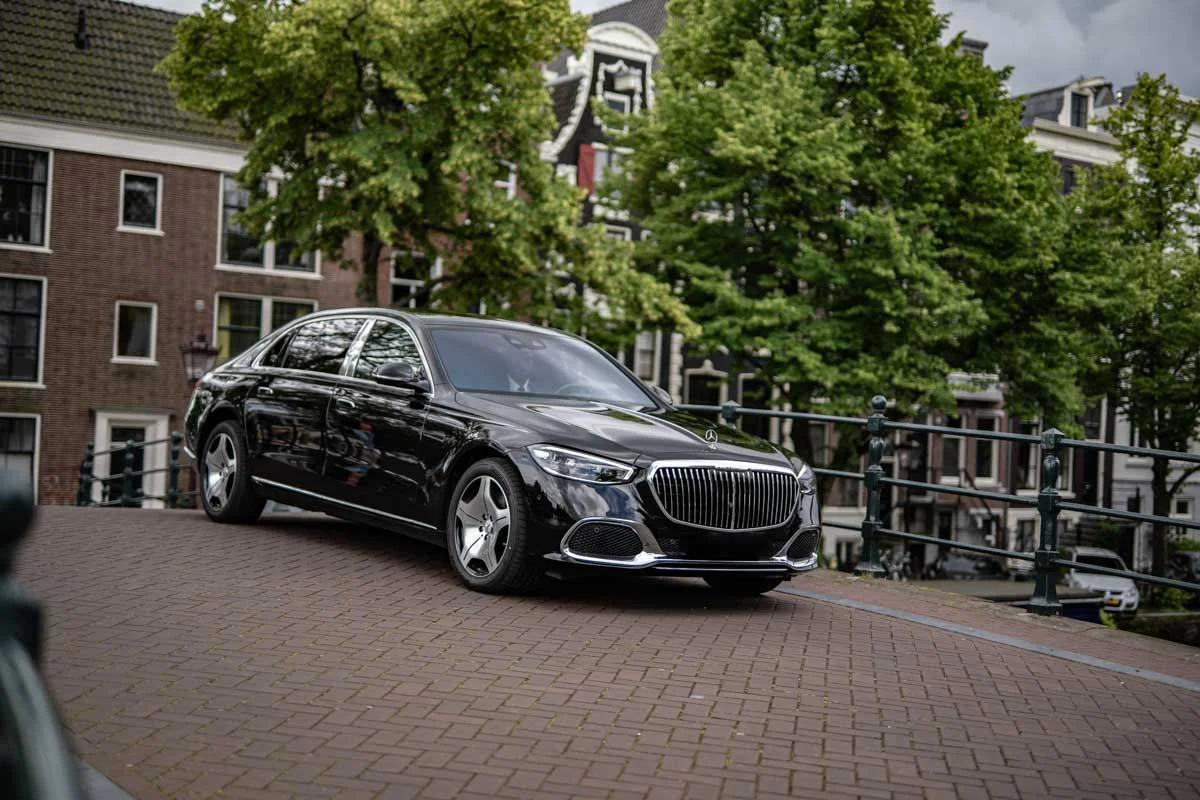
Chauffeur Service in Haarlem: The Quiet Side of Amsterdam
Chauffeur service in Haarlem: Schiphol transfers, the North Sea beaches at Zandvoort, bulb-field season and a medieval centre cars cannot enter.
How to Become a Chauffeur: Licences, Skills and Getting Hired
How to become a chauffeur or private driver: the Dutch taxi driver card explained, licensing across Europe, what operators actually screen for, and the real job.

Wedding Transportation: Moving the Guests, Not Just the Couple
A practical wedding transportation guide: shuttle loops, vehicle mix, timings that hold, late-night returns and the contingencies that save the evening.